2013-14 Magnet/eChoices site is LIVE!

Magnets, Lotteries, Points, Oh My!
by Tanya Anton | GoMamaGuide.com

It’s that time of year again. Only earlier.

The 2013-14 Magnet/eChoices Brochure is available, the echoices website is now LIVE and accepting applications, and the application deadline is ONE MONTH EARLIER than last year.

Beginning today, Monday, October 8, 2012 through the deadline Friday, November 16, 2012 at 5p, LAUSD residents may apply to the Magnet Program, Permits With Transportation (PWT) and/or the Public School Choice (NCLB-PSC) program.

Visit echoices.lausd.net. ONLINE. 24/7. It’s easy. It’s fast. It’s paperless.

Highlights for 2013 – There Are Several Notable Changes:

-The Big One:  This year you will get to list up to THREE magnet choices. (Yup!!) Your points will only go towards your 1st choice, so your 2nd and 3rd choices will go to the bottom of the wait list, but still it’s a better chance than if you hadn’t applied at all.

-For what it’s worth, most competitive (ie. highly desirable) Magnet programs rarely exhaust their wait list, so being added to the bottom of the list with no points seems like a choiceless choice to me, but hey, it has the “appearance” of offering students more choice.

-Caution: Only select magnet programs you might actually WANT to get into, otherwise if you do get into a magnet program (even your 2nd or 3rd choice) and turn it down, you will lose your accumulated wait list points, so think carefully about your selections. Tread lightly, and smartly. As always, I’m here to help consult if need be.

– If your home school is Program Improvement (most middle and high schools are PI), you will now be able to apply to BOTH the NCLB-PSC program (the District will select ONE non-PI school assignment for you) AND up to 3 Magnet choices. Select Option B-the combo platter. Once you are accepted into a program, you will be removed from other programs and NO wait list points will be accrued. (In previous years you had to choose either the Magnet or the PSC program. Now you can select Option B and go for both.)

The Basic Highlights:

-Only open to LAUSD residents

-The application timeline is a month EARLIER than last year

-You can apply online 24/7 during the application window: Oct 8, 2012 – Nov 16, 2012 5p at echoices.lausd.net

-You can also pick up a paper booklet/application at most local schools and some libraries

-Minimum age: your child must turn 5 by Oct 1, 2013 to be eligible for Kindergarten in 2013

-Make sure you select a Magnet program your child is age-appropriate for, (some Magnet programs don’t start until 2nd or 3rd grade; you can’t apply to Kinder when your child is 3)

-Twins: each child needs a separate application and are treated as individuals. If only one gets in, the Sibling points will apply the following year.

-Magnet tours are happening now, October through mid-November, so get out there and tour some schools!

-There are virtually no more “overcrowded points” due to all the newly built schools and the entire district going on Early Start Calendar. (3 exceptions: Del Olmo EL, Cahuenga EL, Bell HS)

-Points are based on your zoned school determined by your residential address regardless of whether you attend or not

-Transportation is available if you live 2 miles or more from your elementary magnet school, and 5 miles or more from your secondary (middle/high school) magnet school

-The maximum riding time guideline for all students (K-12) one-way is 90 minutes

-The more points you have, the better your chance of getting into your 1st choice Magnet.

-It’s a random lottery so anything can happen.

-If you are currently attending a Magnet school, you don’t need to re-apply each year unless you are matriculating (from EL to MS, MS to HS, or wish to enter the lottery to switch to another magnet school

-You will be notified in writing of either acceptance or wait list status by March, 2013.

-Students may be contacted regarding an opening all the way up through the first MONTH of school. (Used to be the first 10 days of school)

-First day of school for LAUSD will be Tuesday, August 13, 2013. (Yeah, love that Early Start! Not.)

-Falsified applications will be disqualified and kicked from the program.

Again, if this seems overwhelming or you want to discuss strategy, please contact me for a consultation. I’m happy to help. Magnets are just one of many public school options.

If you are hunting for a middle school and live on the Westside, come to a free Westside Middle School Forum where 10 area middle schools will present under one roof next Thursday, October 18 at 6p at Coeur d’Alene Elementary School in Venice. details.

“Ready For School, Ready For Life” Panel Discussion Oct 11

“Ready For School, Ready For Life” Speaker Series Panel Discussion
I’ll be joining Christina Simon and Porcha Dodson of “Beyond The Brochure” as well as Director Julie Dubron for a lively school discussion, at Kehillat Israel Early Childhood Center in Pacific Palisades on Thurs, Oct 11th at 7:30p.

For more information please contact Jen Madamba 424.214.7482 or by email Jen.Madamba@kehillatisrael.org by October 8, 2012

or click HERE.

Super Two, What To Do?

Waiting For Kindergarten

I get that it’s stressful being a parent and naturally we all want the best for our children, especially when it comes to nurturing their potential and wanting to make the very best school decision we can for them. But every now and then I get a question thrown at me that warrants a longer discussion. This is not a new question. Actually, it’s one I hear more often than you think. So, for all you parents of brilliant two year-olds, this one’s for you!

Q. “I have a 2 1/2 year old daughter. Growing up in the shadow of her older brother (just turned 6), my daughter is leaping ahead of her peer group, and is super smart to boot. Because she was born in January, she will not be eligible to start Kindergarten until 2015. Having already spent 8 months in preschool, I can’t imagine keeping her there for 3 more years. Would you be able to advise me on getting her a permit for early admission into Kindergarten (I am hoping for a 2014 admission). I am looking to find out what I have to do and who I have to talk to in order to petition for early admission. Looking forward to hearing from you!”

A. Thanks for writing to me. While I can appreciate your concern and best intentions as a parent, it is still WAY too early to do anything about an early admission for your daughter as far as public elementary school goes. Age cut-offs are a matter of state law, not individual school districts, or even individual public schools.
.
That being said, my advice to you is to get her into a great preschool program (which might mean moving her if the current one is not providing enough depth and exploration), monitor her progress with her teachers, and when she is 4 years old, re-assess the situation and start to make plans. This might include:
.
1. Enrolling her in a 2-year Kindergarten sometimes called a DK – or Developmental Kindergarten when she is 4. Many charters offer this.
.
2. Speak to the principal where you son is enrolled to see if you can petition/appeal to have her admitted early (this is rarely done these days due to state law mandates but not impossible.) Just know that if you ask an elementary school principal about a 2 1/2 yr-old they most likely will not take you seriously so wait another year and a half before you approach the situation.
.
3. Look into Montessori schools that allow children to work at their own pace (some go up into grade school and beyond), or
.
4. Consider private schools for her as they are more flexible on the age cut-off as they have the flexibility to determine their own internal age cut-offs.
.
5. At 4 you could also consider whether or not to have her tested to see if she qualifies for a gifted program.
.
Mainly, the age you should begin this process in earnest is when she is 4, not 2 1/2.
.
Dialog at this point should be between you and her preschool teachers. A good preschool will support and stimulate all kinds of development beyond what we typically think of as “academic” learning.
.
Ideally, a quality preschool is a place where your child can experience group work, team work, a solid sense of self, learning to express oneself but also being mindful within the context of the group, fine-motor skills, ability to focus and stay on task for longer periods of time, social-emotional development, including making, developing and sustaining friendships, discovering connections to each other, their environment, their world, stimulating curiosity, problem-solving, conflict-resolution, inquiry, exploring possibilities, creativity and creation, and drawing conclusions. While not exactly “academic,” these are developmental skills that will build the foundation to serve her throughout her life.
.
I know we all mean well, and it’s hard to be patient and watch our budding child unfurl in real-time as opposed to projecting various scenarios on them in fast-forward, but truly these are magical times right here, right now. Enjoy them for what they are, as, coming from a mother of a nearly Middle-Schooler, they surely are fleeting.
.
I told another stressed-out mom of a 2 year-old in my seminar last night, “This is a good time to survey the land, get a sense of what your elementary school options are, and get informed, but really, there’s nothing you can do about it yet, so relax. Have a glass of wine. Know it’s all going to be OK.”
.
Sending love out to all you parents…

The Conversion Charter…Trending Now

by Tanya Anton | GoMamaGuide.com

With 6 LAUSD neighborhood schools converting to affiliated charter status last year and 25 more schools converting this year, we ask, is it contagious? A sign of the times?

 Why would your perfectly good neighborhood school convert to affiliated charter status anyway, you ask?

It all comes down to the 3 Fs. Flexibility, Freedom…and Funding.

An affiliated charter is a unique sort of “charter lite” or hybrid model that was created in LAUSD to pacify all parties. While this type of charter doesn’t have the full autonomy an independent charter school has, they do have increased autonomy from the traditional district model.

A typcial LAUSD neighborhood school that converts to an affiliated charter school can keep its existing campus and facilities -no fighting for space or co-locations via Prop 39. They also keep their attendance area -maintaining the feel of a neighborhood school with priority enrollment given to area residents. The UTLA teacher contract and District-paid union positions stay in tact -but with it so does tenure and seniority-based bumping rights. The school gains some limited freedoms from the district – and the feeling of semi-autonomy. Most importantly the school once converted can apply to the state for a block charter grant -direct funds based on enrollment numbers, which can make up some of the budget shortfalls the school sustained as a non-charter.

While still overseen by LAUSD, an affiliated charter creates its own site-based governance system typically made up of parents, staff, and administration, so the decision-making body of the school resides on campus, not downtown. The school also gains flexibility in curricular focus, textbook selection, selecting programs and materials, as well as freedom in deciding how to allocate, manage and spend the funds that come unrestricted from the state.

The district still oversees and controls many policies in an affiliated charter, and when lateral budget cuts are made – when a staff position or program is reduced or eliminate districtwide – affiliated charters are affected. When the district decides to change the calendar and implement “Early Start,” or makes changes to the bell schedule, or the number of instructional days, class size ratios, or changes to the graduation A-G requirements – affiliated charters are affected. So ultimately, it’s a compromise. The District maintains some control, the unions maintain their contracts, and the school site gains some autonomy without going full-out independent charter.

There is money involved, surely, particularly important for schools that have fallen just below the now higher Title 1 (poverty level) school threshold. In fact, the majority of the schools that have converted one by one (or seven by sixteen) to affiliated charter, are schools that have lost their Title 1 status, meaning they have lost their additional federal funding. The loss in federal funds, in additional to the continued onslaught of yearly state and district budget cuts, has been devastating.

For an elementary school in LAUSD, already 48th in the country in per-pupil spending, the Title 1 funding loss can amount to $80-150,000 annually from a school’s operating budget. For a secondary school such as the highly-lauded LACES, the loss from their budget this year was $460,000. For Millikan Middle School, the loss was about $600,000. You can see the kind of fiscal pressure a school is under, and why that charter block grant, not to mention the thought of gaining some autonomy, starts to look not only attractive, but necessary for survival.

Read some commentary on it from School Board member Tamar Galatzan HERE. And KPCC takes a look at the issues HERE.

But what does this mean in terms of trends where predominantly high-performing motivated middle class schools capable of self-governance are converting to charter 25 – 30 at a time? What does it mean for the rest of the district’s schools, where high staff turnover, low parent participation, and unmotivated communities do not, or can not, advocate for their schools?

In California we have more students enrolled in charter schools than anywhere else in the nation. Ten years from now, will the majority of our schools be charters? Will the District be bankrupt? Will we (the people, the policy-makers) make public education a priority, an undeniable human right, a necessary investment in our collective futures, or will it become an obsolete novelty gone the way of social security and pension plans?

In updating my color-coded Valley Elementary school map with all the recent charter conversions, there is a clear green line. The charter line. Schools south of the Ventura Freeway in the foothills, in North Hills, and Granada Hills, see the most conversions. Make no mistake, they’re also the areas with the highest property values.

GoMamaGuide’s Valley Elementary Schools Map.

.
.
 
.
 
.
 .
.
.
.
.
.
.
.
 
.
———
Want to use this article? You can as long as long as you include this complete blurb with it:
 
Tanya Anton is the creator of GoMamaGuide.com helping parents demystify and navigate their public school options in Los Angeles. To read more articles by Tanya or to learn about her Guidebooks, House Chats, Consultations, and Seminars, visit GoMamaGuide.com or email us at GoMama@mac.com.
© 2012 by Tanya Anton, GoMamaGuide.com All Rights Reserved. 

Dual Language Immersion Programs: Another Option

by Tanya Anton | GoMamaGuide.com
 .
So you’re looking for a Kindergarten and you’re beginning to buckle by the weight of so many choices…your neighborhood school, that other neighborhood school, magnets, charters, permits, oh my!
.
Well, here’s another option to consider. Language immersion.
.
Dual-Language immersion programs are not new, but they’ve been steadily growing in popularity as an alternative path that gives the gift of bilingualism, multiculturalism and a more robust world view.
.
It’s no secret we’re a global melting pot here in Los Angeles. We represent many cultures and speak many languages. In LAUSD in 2010-11 almost 30% of our incoming Kindergarteners were English Learners.
.
Dual Language immersion programs offers non-English speakers the opportunity to learn in their own language as well as English, while teaching English students to learn and integrate another language, building a bridge to both languages and cultures. Unlike taking a language class as an elective, these programs teach core subjects in both languages so the level of language acquisition and comprehension is much deeper. The goal is for students to master grade level content while learning to speak, understand, read and write in both English and the target language.
.
Some programs offer a total immersion in one language for the first year, and then a gradual movement toward the other language in subsequent years until the two are balanced. This is called the 90-10 model. Some programs teach half the core subjects in English, and the other half in the other language, the 50-50 model. In either model, students are grouped to represent both native languages equally, and they both learn from each other. Because the program is so specialized, it deserves a full six-year (K-5) commitment in order to gain the maximum benefit of proficiency, and students will exit elementary school proficient in both languages.
.
While it might take longer initially to master core subjects while learning in two languages, students will not only catch up over time, but research shows that those who achieve advanced levels of proficiency in two languages often experience cognitive and linguistic advantages when compared to monolingual students. Bilingual students perform better on tasks that require divergent thinking, pattern recognition and problem solving, and have higher levels of metalinguistic awareness. Plus, it’s just cool. It’s forward thinking in a We are the World, We are the Children kind of way.
.
On the Westside of Los Angeles, families have several Dual Language elementary school options: Edison in SMMUSD (Spanish), El Marino (Spanish and Japanese) and La Ballona (Spanish) in CCUSD, Grandview (Spanish) and Broadway (Mandarin) in LAUSD, and Goethe International Charter (German).
.
In SMMUSD, John Adams Middle School and Santa Monica High School offers a continuation of the Spanish Dual Language program for students who started at Edison.

In LAUSD, Mark Twain Middle School offers a continuation of the Dual Language program in Spanish, has a Spanish, French, Korean, Japanese World Languages Magnet program, and will be the future home for matriculating Broadway Mandarin Academy students. Venice High School offers a World Languages and Global Studies Magnet program, offering French, German, Italian, Japanese, Mandarin and Spanish, as well as International Relations and Global Studies.

Tour, ask questions, and investigate your options.
.

Read more:
NYTimes “The Benefits of Bilingualism” Op-Ed, here.
LAUSD Dual Language Program info, here.
The full LAUSD Dual Language Directory, here.

———–

Want to use this article? You can as long as long as you include this complete blurb with it:
 
Tanya Anton is the creator of GoMamaGuide.com helping parents demystify and navigate their public school options in Los Angeles. To read more articles by Tanya or to learn about her Guidebooks, House Chats, Consultations, and Seminars, visit GoMamaGuide.com or email us at GoMama@mac.com.
© 2012 by Tanya Anton, GoMamaGuide.com All Rights Reserved. 

Magnet Madness: The Recap

by Tanya Anton | GoMamaGuide.com

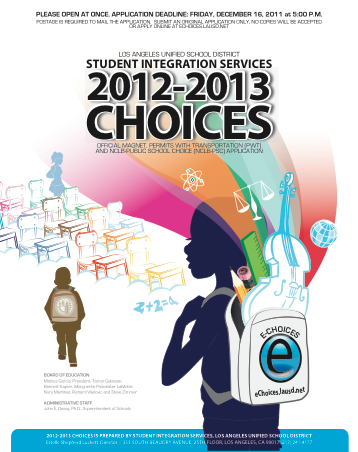
echoices.pngBetween now and December 16th, getting in that Magnet application choice is on many of our minds…

Which Magnet should I choose, how many points do I have, how many points gets you in, what’s the best way to bank points, what are my odds, am I trying to get in, am I trying to NOT get in, what if I do get in, what if I don’t get in, what if… So. Much. Angst!!!

Take a deep breath and trust you’ll get through this. The Magnet lottery is the first in a series of public school options one can apply to with its application window opening November 1st for the following fall. (Charter and other applications typically become available after the new year.) The hard part is you only get to choose ONE magnet school to apply to, and after that, there’s nothing you can do but sit back and wait to see how you did.

New for 2012 – The Choices Highlight Reel

The Magnet/Choices applications are (finally) online! Some old-school paper applications were sent to local schools and some public libraries, however most parents are encouraged to apply online. It’s fast, it’s easy, it’s paperless! And did I mention that it’s online?!

Deadline to get that application in is Friday, December 16, 5pm. After that, most LAUSD schools will close for a 3-week Winter Break.

Magnet tours are happening now folks, so get out there and tour!

Your child must be 5 by November 1, 2012 to enter Kindergarten in Fall 2012.

Remember, LAUSD’s Fall 2012 school calendar will now start on August 14, 2012.

Overcrowded points are becoming virtually extinct. Only 2 schools (Del Olmo EL and Cahuenga EL) will remain on a concept 6 (3 track) calendar by 2012, making those students the only ones eligible for the additional 4 Overcrowded points. For everyone else, it means the most points we could possibly accumulate is: 12 Waitlist or 12 Matriculation + 4 Phbao + 3 Sibling = 19 points max. A more even playing field.

According to the new brochure, “students may be contacted regarding an opening up through the first month of school.” (Used to be the first 10 days of school.)

Any LAUSD resident can apply to a regular Magnet program but for Gifted/High Ability or Highly Gifted Magnet programs one must meet eligibility requirements either through being tested or identified prior to application deadline. If applying from a charter or private or pre-K school, the verification process can be found here. (It’s different than if currently attending an LAUSD school.)

Some Basics

Must be a resident of LAUSD.

You only get to choose ONE program (Magnet or NCLB PSC or PWT if eligible).

You only get to choose ONE Magnet school.

No early applications – apply in the winter before the fall of age-appropriate enrollment.

It’s a weighted lottery so the more points you have the better your chances are.

If you are offered a spot and turn it down you lose all your accumulated wait list points.

If you are currently attending a Magnet school, you don’t need to re-apply each year unless you are matriculating or wish to enter the lottery for another magnet school (from EL to MS, MS to HS, or to switch to another magnet program.)

It’s a random lottery so anything can happen.

For NCLB-PSC or Public School Choice – you must be currently enrolled in a PI school to take advantage of that program.

Transportation is available if you live outside a 2 mile radius from the magnet school’s attendance boundary for K-5, or 3 mile radius for grades 6-12.

Stumped on all this Magnet talk? Come to my last-minute seminar, Navigating The School System: Know Your Public Options, Sunday, December 11th at 5p in WLA and we’ll go over all this and more.


Want to use this article? You can as long as long as you include this complete blurb with it:
Tanya Anton is the creator of GoMamaGuide.com helping parents demystify and navigate their public school options in Los Angeles. To read more articles by Tanya or to learn about her Guidebooks, House Chats, Consultations, and popular Seminars, visit GoMamaGuide.com or email us at GoMama@mac.com.
© 2011 by Tanya Anton, GoMamaGuide.com All Rights Reserved.

Waitlisted

by Tanya Anton | GoMamaGuide.com

waitlisted Many clients have contacted me recently after finding out either their child was waitlisted at several places and they haven’t heard anything yet, or they got into two or more schools and can’t decide which way to go.

Being waitlisted is a sensitive topic. Nobody likes to hear they didn’t get into their first choice school. Some high-performing magnet and charter programs are so competitive to get into, hundreds or even thousands of children are waitlisted every year. So, what’s a parent to do?

First, it helps to understand the application/ lottery/ enrollment process so you know what you are dealing with. Savvy parents know that most folks apply to multiple schools but obviously can’t attend all those schools. Therefore, by their very nature, waitlists become bloated and not necessarily reflective of who would actually attend if given the slot. In other words, if I applied to schools A-E, got accepted and enrolled in school A, my spots on the B-C-D-E school waitlists would be technically vacant since I’ve already enrolled elsewhere. As people finalize their school decisions, other folks are silently moving up waitlists all over town, so you never truly know where you stand on a list.

Second, it helps to know the timeline so you can gauge where you are in it and what your possibilities are.The first round of Magnet notification letters go out in early April. Charters all do their lotteries independently, but typically their letters are sent out in the March-April window. (Earlier for middle and high school.)  Permits and Open Enrollment results typically come out in June. After the first round of offers go out, schools will work their way down the waitlist through May and June in order to fill empty spots, but even then enrollment lists are not necessarily final yet, as families shift in their enrollment decisions. School offices close for the month of July, so this is a good time to vacate, have a cocktail, de-stress, as there’s absolutely nothing you can do this month until offices reopen sometime in August, when they’ll continue to work down the list to ensure all seats are filled. Hopefully you will know your school choice by then, but even as late as late-August or early-September, last-minute seats can be offered. Remember, Magnet schools have up until the 10th day of school to notify you if a spot opens up, and neighborhood schools have until Norm Day, usually the first week in October when they finalize their teacher-student ratios to the District, so really, waitlisted isn’t final until then.

Third, stay positive and be proactive. Don’t bug the staff as they are most likely overworked and underpaid, but you can call, say, in late June or mid-August, to see if getting your child in is a close possibility or not very likely. You can also let them know who you are and how very thrilled you would be to accept a spot at their school, should one open up.

And finally, always have a back-up plan. Perhaps that’s your home school which you’re automatically zoned for, or one with a large number of Open Enrollment seats where almost everyone who applies gets in. Perhaps it’s a new magnet program that was announced late and didn’t fill up, or you apply for a PERT – a Parent-Employment-Related Transfer to a school near your business address. Either way, looking back at it, kids always find a seat somewhere.

Confused about your public school options? Can’t decide or want me to go over your choices with you? I can help. Book a 30 or 55min phone consultation with me today.

© 2011 by Tanya Anton, GoMamaGuide.com All Rights Reserved.

API, AP What?

by Tanya Anton | GoMamaGuide.com

May is typically the month where students spend up to two weeks testing their knowledge of grade-level standards. Standardized testing is mandated for all public school 2nd through 12th graders as part of the No Child Left Behind Act former President Bush signed into law in 2002. Test results are used to calculate each school’s Academic Performance Index (API) and Adequate Yearly Progress (AYP). Schools are required to progress up 5 points every year and meet all target demographics in the school, which, if not met, can come with steep consequences.

That API score, or overall school test score, is one of the first things parents tend to look at when considering a school for their child, but is it the best way to measure a school? Is a high score all it’s cracked up to be? Does a lower score mean the school is no good? What does that API number really tell us?

API scores tell us how students performed on a series of tests over the course of a couple of weeks the previous spring.

But test scores are NOT indicative of the quality of a school’s educational experience. For my elementary school parents, they merely measure how a group of students, (last year’s 2nd-5th graders), tested in that particular week of spring testing in the subjects of English Language Arts and Math, with some 5th grade Science.

Test scores do NOT tell you what kind of teaching is going on, what the learning environment is like, how effectively teachers communicate and interact with the students, if the school fosters positive social-emotional development, or if students come away with a sense of curiosity, a love of learning, or long-range comprehension which becomes the base with which to scaffold deeper meaning and higher knowledge.

Test scores do NOT indicate what other subjects and enrichments students are exposed to, if they are given opportunities for hands-on learning, exploring alternative learning modalities, working in teams, mentoring or accelerated differentiation where needed, or if instead, students are grouped and repetitively drilled in the basic test subjects of English and Math — sometimes referred to as the “bread and water” of public education.

I have seen parents pull their kids out of high-performance schools that may look better “on paper,” (scores in the upper 800s to low-mid-900s), when the actual classroom experience turned out to be stressful, repetitive, and threatening a child’s innate love of learning.

Dianne Ravitch, one of the architects of No Child Left Behind in George W. Bush’s Department of Education, says she now feels that it was all a big mistake. 

“The basic strategy is measuring and punishing,” Ravitch says of No Child Left Behind. “And it turns out as a result of putting so much emphasis on the test scores, there’s a lot of cheating going on, there’s a lot of gaming the system. Instead of raising standards it’s actually lowered standards because many states have ‘dumbed down’ their tests or changed the scoring of their tests to say that more kids are passing than actually are.”  Full story.

Sure, we all want our kids to be able to read, write and do their arithmetic, but is that where the majority of the focus should be?

The best way to get a feel for a school, more than just looking at test scores, is to get on campus, take a look around with your eyes and your gut instinct, meet the people involved, ask questions, and have a direct personal experience there. Scores can only tell you so much.

© 2011 by Tanya Anton, GoMamaGuide.com All Rights Reserved.

Why Public School? (The Backstory)

by Tanya Anton | GoMamaGuide.com

written March, 2007

Many people have asked me why I have become so active helping parents navigate the challenging, not so top-of-its-class public monolith that is LAUSD. It’s a good question, one I wrestle with constantly.

I suppose I never would have even considered public school education reform a serious issue to focus my energies on prior to becoming a parent. As a matter of fact, collaborating, building community, gathering info and sharing answers with others was only done if it involved musicians, a gig, and some cashola…for me.

Nine years ago, when we bought into this sleepy little Westside neighborhood, a mostly retired blue collar, post-war community, the last thing on our minds was school districts. In fact, I distinctly recall our housewarming announcement. It stated matter-of-factly: “No rings, no kids, no nonsense. (To answer your next question.) But please bring a bottle of your favorite wine.”

Er herm. Yes, well.

Now that I’m married, with child, specifically child about to enter Kindergarten, it seems that there’s a whole mess of nonsense around here to wade through.

Cue favorite wine, please.

The only reason we landed over here to begin with is because the lots were bigger (I wanted a patch of green), slightly more affordable, and we needed a detached garage to house the new recording studio we were going to build. We didn’t want a postage stamp-sized lot with neighbors breathing down our backs as musicians came and went day and night pushing their Anvil cases up and down the driveway. Little did we imagine that with the advent of computer technology, sampling, flying tracks and vocals over the ‘net, the need to actually SEE musicians anymore is a rarity indeed, but that’s beside the point.

By a stroke of good fortune and incredible timing on my husband’s part, we ended up in our little fixer-upper neighborhood almost a decade ago. Who knew it would eventually become a desirable family destination?

However, it is quite simply unacceptable to me that the average price these days for a 1-story, 1200 sq ft tear-down over here has risen to just shy of a million dollars, and yet our local schools are in such a sorry state parents seem to be abandoning them left and right for anywhere better. Now if you can afford the additional $18-25K (choke, wheez) per child per year for private elementary school on up, bravo to you. But some of us just can’t. We need other options. We need public options. You know, for the people. The just folks. Not the let’s-hemorrhage-money-just-because-we-can type folks.

And furthermore, if the real estate values are where they are, I damn well think my kid ought to be able to go to her neighborhood school and get a decent education. Right?

There are many problems, but a big one is size. LAUSD services almost 750,000 children and is the 2nd largest school district in the country. That means that the tax dollars we throw into the kitty over here in our hot little neighborhood get dispersed with everyone else’s, and wind up all across this urban sprawl, not just in our own back yard.

Another issue we’re facing is this very real post 9/11 baby boom. I see it on the ballooning mom boards and on the ever-growing preschool wait lists. There is a swell of kids just about to enter the school system. I have heard many parents tell of even being willing to pay the 20-some-thousand-dollars per year for private school, applied to 5 or 6 of them, and then didn’t get in. Any of them. Too many children, not enough slots. That’s just the reality of the situation. And each year as this boom (and their siblings) enter Kindergarten on up, the available slots per applicant will get even slimmer. Those children will have to go somewhere…perhaps back to their neighborhood schools.

I’ve heard it said that if the state of California were a nation–what with the output of Silicon Valley, Napa Valley and the entertainment industry–it would be ranked the 7th or 8th wealthiest country in the world! Yet we are ranked near the bottom of the country for public education. Our schools just don’t line up with what Californians are capable of. With all our resources, intelligence, ingenuity, creativity, wealth…couldn’t we do better educating our next generation?

So, what’s a concerned parent to do?

Luckily, there ARE public school options. If you know about them. If you apply correctly and on time. There are magnets, independent charters and converted charters, inter and intra-district permits, each with their own application rules, procedures, timeline and lotteries. Additionally, many neighborhood schools are really improving as parents roll up their sleeves and get involved.

In an attempt to sort through and understand all this, I began coordinating parent ed nights at our preschool a few years ago to discuss the options and the process, bringing in alumnae parents who’d already been through it for one event, and both a magnet and charter elementary school principal for another event. I went on countless school tours, and sat in on local PTA and booster club meetings at neighborhood schools, keeping tabs on their initiatives and progress.

Branching out to an even wider community, I agreed to join humorist Sandra Tsing Loh and author Christie Mellor, along with The LA Times, a vodka sponsor, generously donated Gourmandise chocolate desserts, and co-hosted a wildly successful “Martinis, Magnets & More,” public school survival seminar on my own Westside turf.

With the flood of emails following these events, I realized the scope of questions parents had, even fundamental ones, which weren’t readily answered by the District. That’s when I sat down and put it all together in one easy-to-understand Guidebook.

At the heart of all this work is to be able to offer nuts and bolts info on school options, how to navigate the often confusing (and disparate) application lotteries, but also to connect parents to each other and encourage them to get involved locally instead of flee.

In addition to writing my guidebook, I have spoken to many preschool parents in an attempt to calm fears and identify their public school options.

On the horizon:

Public speaking to prospective parents, preschools, booster club leaders, community leaders.

More Westside public school community events.

Considering ways to unite core parents from different schools to share successful strategies, resources, and support, working together to grow our neighborhood schools.

Perhaps I will give up this noble idea of community activism and become instead a private, self-serving, mind-my-own business capitalist as so many have done before me. But then an idea strikes me, and I envision an intuitive way to proceed.

Though at times I resist it, I feel called to do this work. Can’t explain why. I just know things, and am not afraid to try them. I actually feel I can make a difference, and am encouraged when others seem to respond when I speak out.

It’s time to revitalize our neighborhood schools. It is already happening in little pockets of dedicated, core parent groups at many neighborhood schools. We’re building awareness and momentum. With a little twist. I hope you’ll join me.

Cheers.